
Project at HIAS
Dialectic of Convenience
At HIAS, John Hamilton will focus on his current project, which bears the working title Culture of Convenience. The study not only examines the historical shifts in the word’s meaning—from a sense of agreement to a general notion of ease, efficiency, and expediency—but also reflects on how convenience has become a dominant criterion for determining what is considered valuable in today’s society. How did “easier” come to be synonymous with “better”? Consequently, the work prompts a sustained reflection on today’s enthusiasm for technological conveniences and seeks to assess the balance—or imbalance—between the useful and the pleasant, between what helps us survive and what makes life worth living.
His Tandem Partner is Cornelia Zumbusch, Professor of Modern German Literature at the University of Hamburg.

Tandem
Prof. Dr. Cornelia Zumbusch, Modern German Literature, University of Hamburg.
Biography
Prior to his appointment as the William R. Kenan Professor of German and Comparative Literature at Harvard University, John Hamilton held teaching positions in Classical Philology at the University of California, Santa Cruz, and in German and Comparative Literature at New York University, as well as a visiting professorship in Classical Philology at the University of Bristol. Previously, he was a fellow at the Wissenschaftskolleg zu Berlin (2005–06) and at the Berlin Center for Literary Research (2009), and he is an active member of the research group “Nachleben der Antike” (The Afterlife of Antiquity), which was originally based in Heidelberg. At Harvard, he co-organized the transatlantic PhD network Das Wissen der Literatur and is co-editor of the series Metaforms: Studies in the Reception of Classical Antiquity (Brill).
John Hamilton’s research covers a broad spectrum of topics and questions ranging from antiquity to the present, with a focus on Western European literary and cultural history. He has published extensively on the reception of classical history (Soliciting Darkness: Pindar, Obscurity, and the Classical Tradition, Harvard University Press 2004), the figure of the mad musician (Music, Madness, and the Unworking of Language, Columbia University Press 2008), and the semantic-political history of the concept of security (Security: Politics, Humanity, and the Philology of Care, Princeton University Press 2013).
Most recently, he developed a theoretical model derived from the Christian doctrine of the Incarnation (Philology of the Flesh, The University of Chicago Press, 2018), wrote an expanded essay on the topic of complacency (Über die Selbstgefälligkeit, Matthes & Seitz, Berlin, 2021, and *Complacency: The Displacement of Classics in Higher Education, The University of Chicago Press 2022), and conducted a study on the French reception of Kafka from existentialism to deconstructionism (France/Kafka: An Author in Theory, Bloomsbury Academic 2023).
His HIAS Fellowship was funded by the ZEIT STIFTUNG BUCERIUS.
Image Information
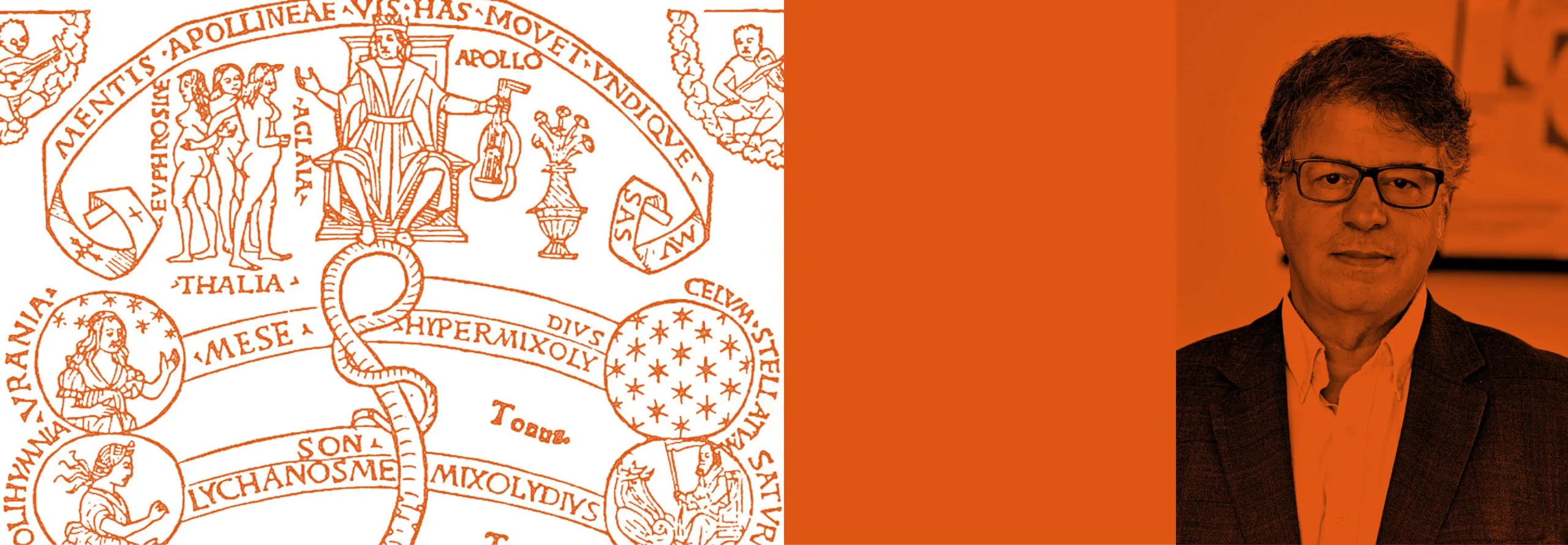
MUSIC OF THE SPHERES Apollo oben auf dem planetarischen Sphären und musikalischen Verhältnisse in Franchino Gaffurio 1492 Buch Theorica musicae
Portrait: HIAS/Claudia Höhne